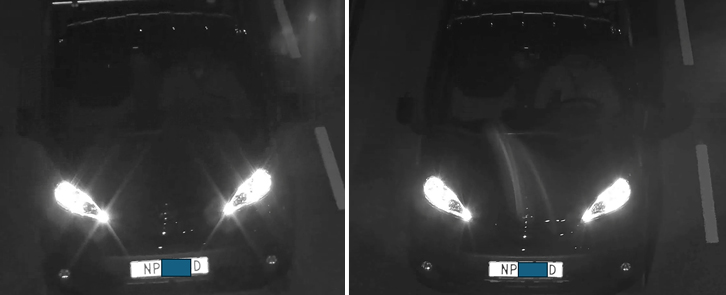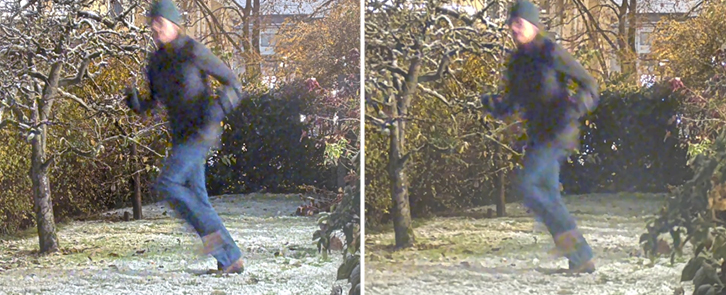
Global shutter vs rolling shutter
Introduction
In security cameras, rolling shutter image sensors are typically used. The fundamental difference between a global shutter sensor and a rolling shutter sensor is the exposure scheme.
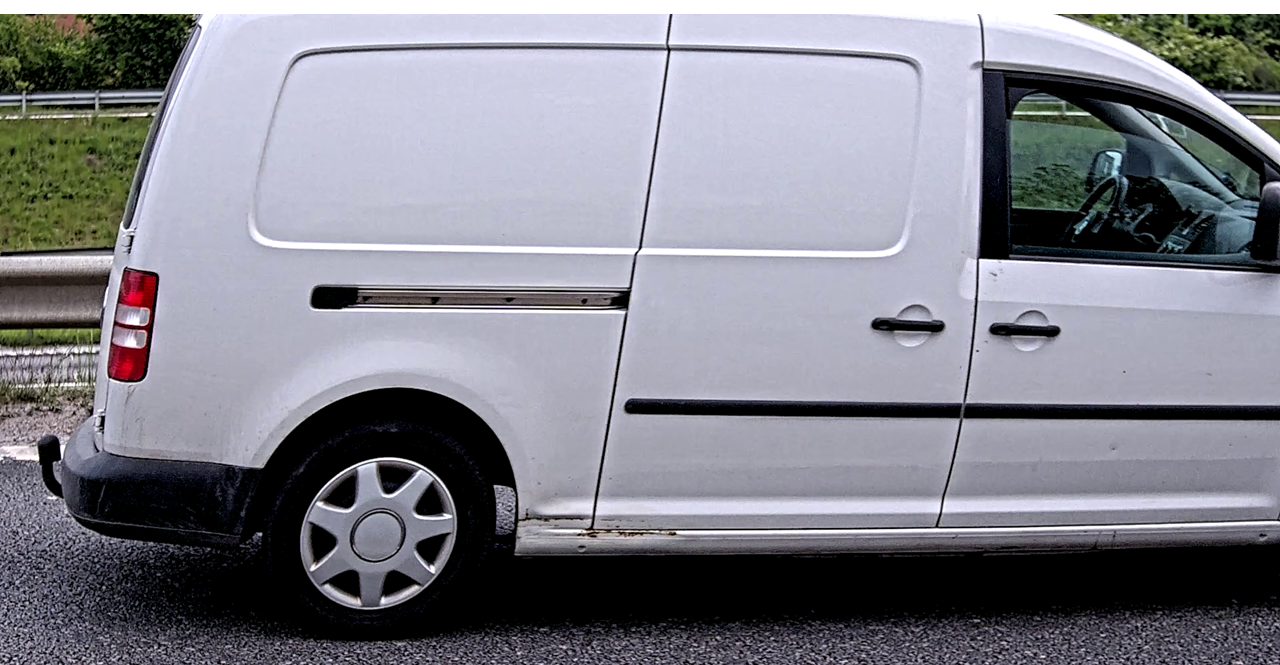
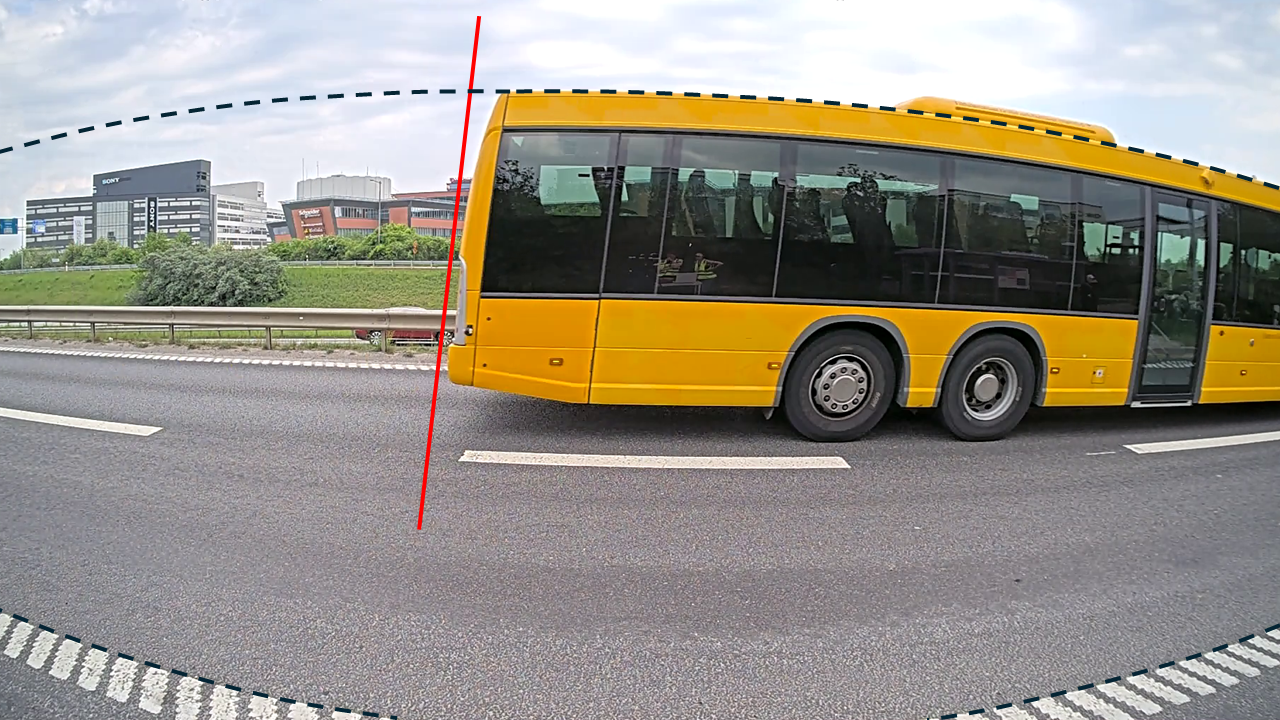
In the case of a global shutter sensor, all pixels are exposed simultaneously, whereas for a rolling shutter sensor, the pixels are exposed row-by-row, with a time offset between the rows. This time offset in row-by-row exposure results in distortion of fast-moving objects, called rolling shutter effect (see the image below). Note that in this whitepaper, we distinguish between motion blur, that is caused by the duration of the exposure, and object distortion, caused by the offset in exposure between rows.
Global shutter sensors only make a difference in combination with a short exposure time. Longer exposures introduce motion blur which effectively hides the rolling shutter distortion and there will be very little to gain by using pulsed illumination. Therefore, the first question to ask is whether your application requires a short exposure time. If it does, then a global shutter camera is likely the right choice.
- Global shutter
- Rolling shutter
A common use case for global shutter sensors is in high-speed processes, such as scanning parcels on conveyor belts or monitoring fast industrial processes where machine vision-driven industrial automation demands high-quality, distortion-free images.
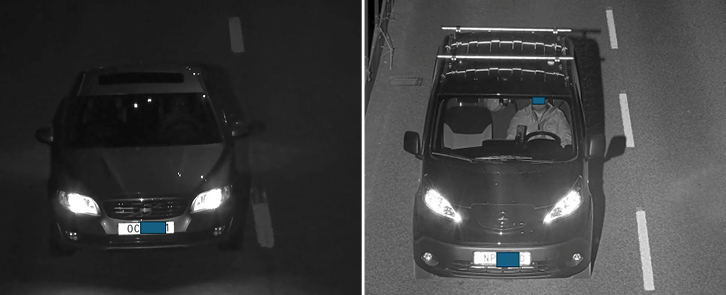
A second use case for global shutter sensors is in traffic installations, where short flashes of high-intensity light facilitate very detailed images of cars moving with high speed and even in-car visibility in low-light conditions.
A consequence of simultaneous exposure in global shutter sensors is the possibility to sync very short flashes of light with the sensor exposure time, which minimizes the overall power consumption of high intensity light. For rolling shutter sensors, using short light-flashes in traffic solutions gives rise to bright bands in the images at typical exposure times (1 ms). For installations containing both global shutter and rolling shutter cameras, issues with bright bands in the rolling shutter image can be mitigated by using Axis synchronized capture.
Exposure schemes for rolling and global shutter image sensors
The role of the image sensor is to convert light (photons) into a digital signal. This conversion can be divided into three steps. The first two steps are done in the pixels. First, photons are absorbed and converted into electrons during the exposure period. The exposure is terminated by an electron transfer step. Second, the electrons are converted into an analog voltage signal. In the third step which is the pixel readout phase, the analog voltage signal is converted into a digital signal by an analog-to-digital converter (ADC).
An image sensor typically consists of several millions of pixels, ordered in an array. However, a common sensor design is to use one ADC per pixel column. This means that the pixel-readout occurs row-by-row.
In a rolling shutter sensor, due to the row-by-row pixel-readout, the exposure time of each row is slightly shifted in time. This time difference in exposure results in a distortion of fast-moving objects in the image, and it’s called the rolling shutter effect.
In contrast, a global shutter sensor exposes all its pixels simultaneously. The exposure is terminated by transferring the pixel signal to an in-pixel-memory. This memory can be located before the electrons are converted into an analog signal (charge domain) or after the electrons have been converted to an analog signal (voltage domain). The signal stored on the memory is subsequently transferred and processed by the ADCs, row-by-row, like in the rolling shutter case. Since all pixels are exposed simultaneously, the global shutter sensor does not suffer from distortion of fast-moving objects.
Rolling shutter distortion – when does it matter?
The amount of rolling shutter distortion visible in an image depends on how large the time offset between the exposure of each row in the sensor is, as well as how fast and in which way objects move through the image.
The time offset between rows on the sensor is determined by the row read-out time of the sensor and the number of rows to be read. A high resolution sensor normally causes more distortion than a low resolution sensor.
If there are no fast moving objects visible in the image, there will be no visible rolling shutter distortion. Rolling shutter sensors today are very fast and can produce distortion-free images of almost any surveillance scene. Often distortion caused by the lens, like barrel distortion, has a much larger effect than rolling shutter distortion.
However, for some cases, a rolling shutter causes severely distorted images. Typically, this applies to things spinning fast, like fans, propellers or motors.
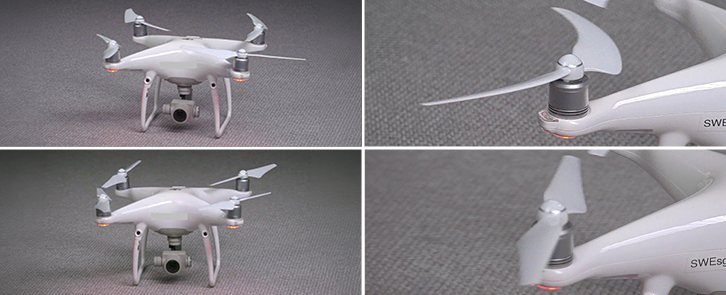
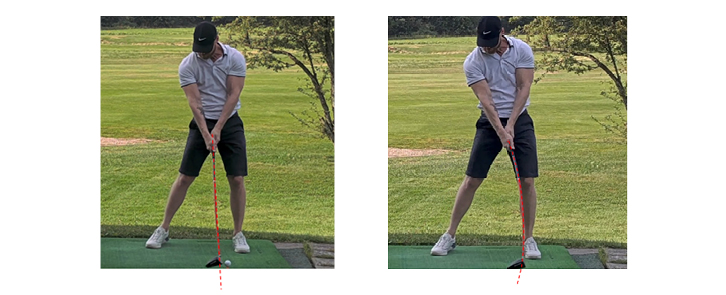
Things that move fast in a straight line through the image, like boxes on a conveyor belt, or cars passing by very quickly, will look tilted on a rolling shutter sensor.
Exposure time
Exposure time does not affect distortion. However, longer exposure time causes motion blur. Motion blur will smear the rolling shutter distortion, making it less visible.
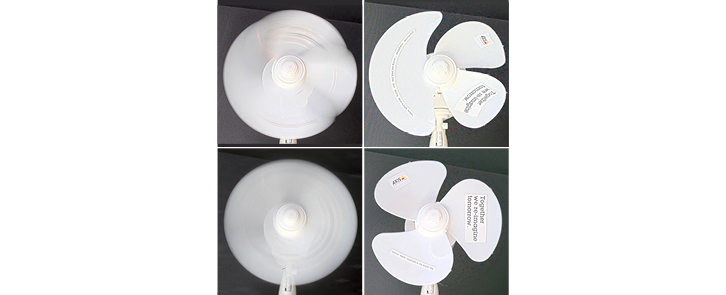
Bottom row: A global shutter camera with long exposure time (1/25s) to the left, and short exposure time (1/10000s) to the right.

Global shutter sensors are in general only needed in applications where things move fast. At the same time, a short exposure time is needed to avoid motion blur. For traffic use cases, a maximum exposure time around 1/1000s (1ms) is common, and for spinning fans or propellers, even shorter exposure times of 1/10000s (0.1ms) might be necessary.
Global shutter with strobing light
In dark conditions, scene illumination such as IR- or white light, can improve image quality. When imaging fast motion, short exposure times are necessary to avoid motion blur. This reduces the amount of light captured by the sensor, increasing the need for scene illumination.
One of the major reasons to choose a global shutter sensor is the possibility to use very short flashes of light instead of continuous light to illuminate the scene. To use strobing light, with one flash every frame synced to the exposure of the sensor, instead of continuous light, can be a way to lower the power consumption of the device without loss of image quality, or a way to boost the peak intensity of the light significantly.
Example: Reduce power consumption of illumination by strobing
A traffic camera uses exposure time 1/1000s (1ms), and a frame rate of 25 fps. The duty cycle of the exposure is then (1/1000s) / (1/25s) = 2.5%. It means that the sensor is only collecting light 2.5% of the time, the rest of the time it is just waiting for the next frame.
If this camera uses continuous IR-illumination (which is on all the time), a large part of the light will never be detected by the sensor.
A better solution would be to switch off the IR-illumination when the sensor is not collecting light. By pulsing the IR-light, and syncing the IR-pulses to the exposure of the sensor, IR-light is only emitted during the time when the sensor is collecting light, which is 2.5% of the time. The power consumption of the IR-LEDs will then be reduced to 2.5% compared to the case with continuous IR-illumination.
During exposure, the sensor sees the same amount of light, so the signal-to-noise ratio (SNR) of the image will be unchanged. There is no loss of image quality.
Example: Boost the peak light intensity by strobing
Using the same traffic camera as above, with an exposure time of 1 ms, and a frame rate of 25 fps, one could also choose to use all the power available and boost the IR-light intensity as much as possible.
Imagine a continuous IR-lamp consuming 20 W of electrical power. Instead of running the LEDs continuously, if we store that power, and then release the full energy once every frame, exactly synced with the exposure of the sensor, we can get much higher light intensity during a short time.
In this example, the duty cycle is 2.5%, which ideally would allow us to boost the IR-intensity with a factor 1/0.025 = 40 times. The peak driving power of the IR-LEDs during the 1ms exposure would then be 800 W instead of 20 W, without increasing the average power consumption which is still 20 W.
Using strobing illuminators enables new use cases in traffic. Continuous IR-light with reasonable power consumption is enough to see license plates clearly. With a strobing IR-lamp with similar consumption, there is enough light to also see details of cars clearly, and even through the windshield and into the cars. This can, for example, be used to detect make and model of cars at night, and to see if the driver has a seat belt or is using a cell phone.
Rolling shutter with strobing light
A flash or strobe can in theory be used with a rolling shutter sensor, if the exposure time is long enough so that the first and last row have overlapping exposure intervals. But if the timing is not right, the strobe can cause very strange image artifacts (see image examples in the appendix).
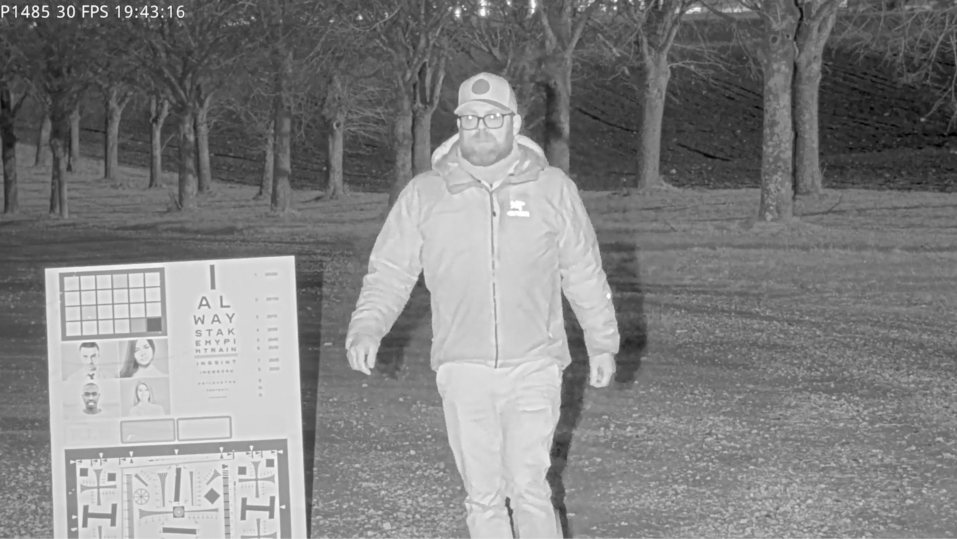
However, for use cases with fast motion and other sources of light, such as traffic, very short exposure times are needed to avoid motion blur. In those cases, there is no overlap in exposure of the first row and the last row of the sensor, and the flash will only illuminate a limited number of rows, resulting in a bright band in the output image.
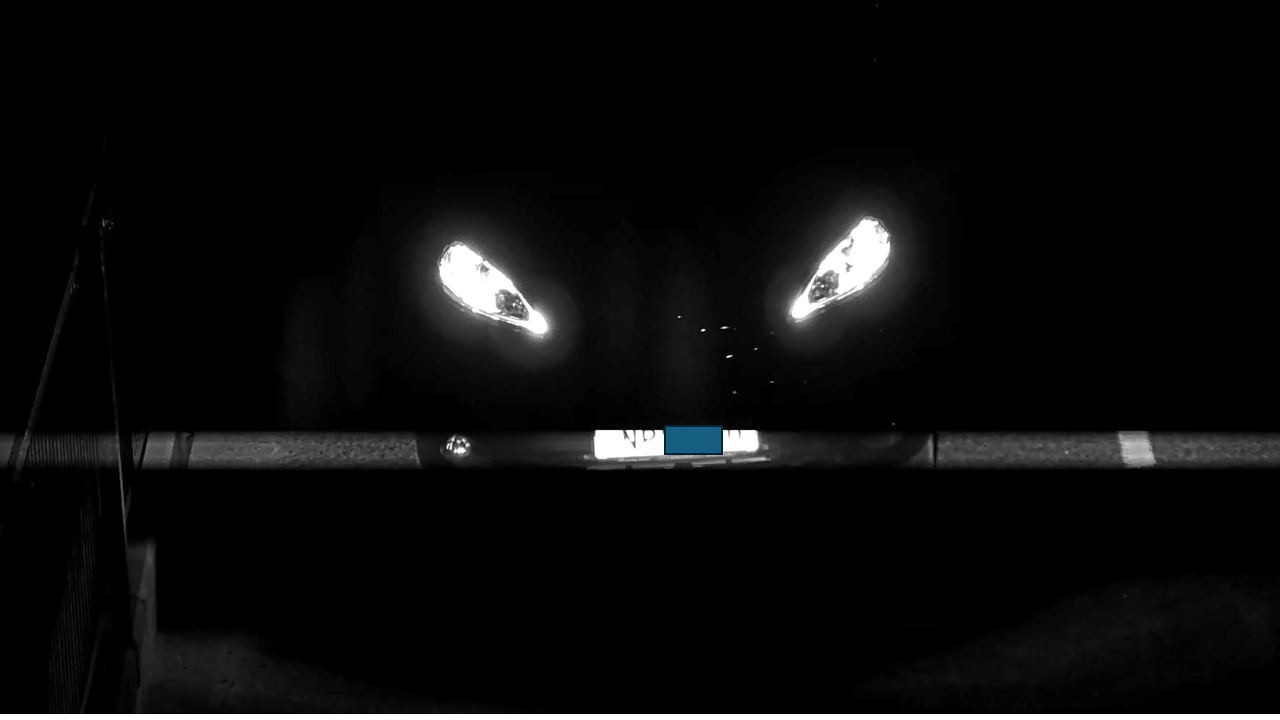
Strobing light in global shutter and rolling shutter mixed installations
At a site where both global shutter cameras and rolling shutter cameras are present, strobing light from the global shutter cameras can cause artifacts on the rolling shutter sensors, for example, bright bands. Depending on the intensity of the light, the strobe pulse length and the exposure time of the rolling shutter cameras, this can barely be visible or make the image of the rolling shutter cameras unusable (see appendix for more image examples).
There are two solutions to this problem, switching off the strobe and using continuous light instead, or using synchronized capture on all Axis cameras.
Synchronized capture
Axis synchronized capture is a feature that allows multiple cameras on the same network to synchronize the exposure of their respective sensors and capture images exactly at the same time. This can also be used to force cameras to be out of sync to eliminate strobing light artifacts from rolling shutter cameras.
When switching on synchronized capture on all Axis cameras in a specific network, they will automatically synchronize themselves so that all rolling shutter cameras capture images simultaneously in a time window 1, and all global shutter cameras capture images simultaneously in a different time window 2, which is out of sync with the rolling shutter cameras. The result is that the strobe light triggered by the global shutter cameras is flashing exactly in the so called blanking period of the rolling shutters – when they are not collecting light but just waiting for the next frame. The strobe light will effectively be invisible for the rolling shutter cameras.
Limitations of global shutter sensors
The pixel design of a global shutter sensor is more complex compared to a rolling shutter sensor, resulting in a higher sensor price. In addition, the noise is typically higher in a global shutter sensor compared to a rolling shutter sensor. This is especially true for global shutter sensors that store the signal in the voltage domain prior to readout. Since this noise is introduced prior to the analog gain step, increasing the analog gain will have limited effect on reducing the noise.
However, the noise level is not telling the whole story when it comes to image quality. A key parameter impacting the image quality is the signal-to-noise ratio (SNR). More light from the scene results in a larger signal in the sensor. A larger sensor with larger pixels as well as a lens with a low F-number will increase the amount of light collected from the scene and contribute to a higher SNR. By designing a camera with this in mind, the extra noise of a global shutter sensor can be fully compensated for, but to a higher price of the camera components.
For night scenes, with little natural light, artificial illumination can be used to increase the SNR and visibility. Using strobing illumination with a global shutter sensor makes it possible to boost light intensity without increasing power consumption. The result is often a better SNR compared to a rolling shutter camera with continuous illumination.
Appendix; practical scenarios and visual examples
At what speed of motion do we see rolling shutter distortion? See the following calculated examples:
This is a complex question since the amount of distortion is related to how fast an object is moving through the image in pixels/s, and not the actual speed in km/h or m/s. It thus depends on several things like resolution, zoom level, distance, and angle to the moving object.
A camera is standing by the side of a road, filming cars flashing by from left to right. The sensor has a resolution of 1080x1920 pixels and an exposure offset between rows of 10 microseconds (1/100000 seconds). For simplicity, let’s assume the height of the car fills up the entire image from top to bottom. If the speed of the car is 30 km/h, the image of the car will be shifted by roughly 64 pixels over the full image, corresponding to a tilt of 3 degrees. If the speed is 100 km/h, the shift will be 213 pixels over the full image, and the car will have an 11 degree tilt.
A camera is sitting 6 m above the road, filming cars 30 m away along the road. The sensor has a resolution of 1080x1920 pixels and an exposure offset between rows of 10 microseconds (1/100000 s). The height of the car fills up about 50% of the image height. Since the car is moving from top to bottom of the image, rolling shutter distortion will cause a compression or stretch of the car (depending on if the rolling shutter goes from bottom to top of the image or from top to bottom). If the speed of the car is 30 km/h, the car will be compressed or stretched by less than 1 pixel, so there will be no distortion. If the speed of the car is 100 km/h, the car will be compressed or stretched by 3 pixels or roughly 0.5%. If the speed is 200 km/h, the car will be compressed or stretched by 6 pixels or roughly 1%. In this case, rolling shutter distortion will not be visible by eye and can be disregarded. The reason is that the angle between the camera and the car is such that the car moves very little through the image, even if it’s moving with high speed along the road.
A camera is zoomed in on a conveyor belt, detecting packages with bar codes moving from the left to the right in the image. The packages are 30 cm wide and fills up the height of the image. The sensor has a resolution of 1080x1920 pixels and an exposure offset between rows of 10 microseconds (1/100000 s). If the conveyor belt moves at a speed of 1 m/s, the packages (and bar codes) will be tilted by 2 degrees. If we speed up the belt to 4 m/s, the tilt will be 8 degrees. In this case, the objects are moving much slower than cars on a highway, but there is still considerable distortion since the camera is zoomed in closely on the objects.
A camera is filming a spinning fan, with a diameter of 40 cm and 30 cm wide blades. The camera is zoomed in so that the fan fills the height of the image. The sensor has a resolution of 1080x1920 pixels and an exposure offset between rows of 10 microseconds (1/100000 s). In this case, rolling shutter distortion will make the blades of the fan look bent, stretched and compressed, in different parts of the image. To keep distortion invisible, say a stretch below 1%, the fan needs to move slower than 0,3 revolutions per second. In the image above, one of the blades is stretched out from top to bottom. This will occur at a speed of roughly 44 revolutions per second.
Image examples:
Strobing light artifacts on a rolling shutter camera:
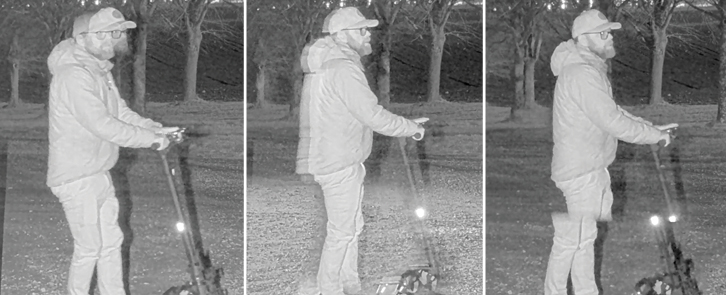
A rolling shutter camera with a long exposure time (1/30 s) next to a global shutter camera with strobing IR-light in WDR-mode. In WDR-mode, there will be two IR-flashes per frame, very close in time. The two pulses cause strange image artifacts on the rolling shutter camera, like double images, or cut images, of moving objects. 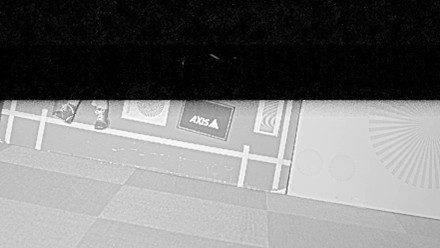
An image from a rolling shutter camera with an exposure time of 28 milliseconds, with an IR-flash which is 1 ms long. The IR-flash covers parts of the image. Scenes where there is no difference between rolling shutter and global shutter: For many scenes and use cases, there is no visible difference between a rolling shutter camera and a global shutter camera. This includes:
Daytime scenes with only moderate motion (people walking or running, cars driving slowly or cars driving fast facing the camera so that the motion through the image is slow).
Nighttime (lowlight) scenes with continuous illumination or no artificial illumination and only moderate motion.
Nighttime (lowlight) scenes with long exposure times (>1/100 s).