
IR in surveillance
Summary
Day-and-night cameras provide continuous 24/7 surveillance by adapting to changing light conditions. During the day, an IR-cut filter blocks infrared light to ensure the camera sensor delivers accurate, natural colors. As ambient light fades, the camera mechanically removes this filter, allowing the sensor to capture both visible and near-infrared light. This transition results in high-quality grayscale video that maintains clarity in near-total darkness. It is important to note that day-and-night cameras are distinct from thermal cameras, which detect heat signatures rather than light.
Some specialized models also utilize an IR-pass filter, which isolates infrared light to improve performance in niche applications like traffic monitoring or long-distance surveillance.
To support day-and-night cameras in pitch-black environments, IR-LED illumination is used. Standalone illuminators can be employed for long-range requirements, but built-in LEDs offer a convenient, all-in-one solution.
Axis OptimizedIR takes this a step further by combining camera intelligence with sophisticated LED technology. Rather than providing a static IR beam, OptimizedIR automatically adjusts the intensity and angle of the illumination to match the camera’s field of view. This prevents hotspots, where objects close to the camera appear overexposed, and ensures the entire scene is evenly lit.
Introduction
Most cameras can use both visible light and near-infrared (IR) light to produce images or video. By adding artificial IR illumination to a scene, it is possible to achieve high-quality video even in completely dark environments.
This white paper describes why IR illumination is widely used in surveillance. It discusses both camera-integrated and standalone illuminators, as well as the unique combination of IR solutions that is labeled Axis OptimizedIR.
Light sensitivity and the electromagnetic spectrum
Light consists of discrete bundles of energy, called photons. The image sensor in a camera holds millions of photo-sensitive spots, pixels, that detect the number of incoming photons. The camera uses this information to create an image.
Light also comes with different energy, or different wavelengths. The ability of a camera sensor to detect photons is dependent on their wavelength. Visible light photons, with wavelengths between 0.4 μm (micrometers) and 0.7 μm, are generally detected, but the sensor can usually also detect photons with slightly longer wavelengths (0.7–1.5 μm) in the near-infrared part of the electromagnetic spectrum. Such light is naturally prevalent, for instance in sunlight, but can be added using artificial light sources as well.
Photons with even longer wavelengths, in the LWIR (long-wave infrared) part of the spectrum, can be detected by a thermal camera sensor. LWIR light is heat radiation, naturally emitted by all living and non-living objects. In thermal camera images, warmer objects (such as people and animals) stand out from typically cooler backgrounds.
1. X-rays
2. Ultraviolet light
3. Visible light
4. Near-infrared (NIR) radiation (approximately 0.7–1.5 μm)
5. Short-wavelength infrared (SWIR) radiation (1.5–3 μm)
6. Mid-wavelength infrared (MWIR) radiation (3–5 μm)
7. Long-wavelength infrared (LWIR) radiation (8–14 μm)
8. Far-infrared (FIR) radiation (approximately 15–1,000 μm
9. Microwave radiation
10. Radio/TV wavelengths
11. IR illumination
12. Axis thermal cameras
In low light, there are fewer photons available that can reach the camera sensor. Cameras with Axis Lightfinder technology have extreme light sensitivity thanks to a balanced combination of sensor, lens, and fine-tuned image processing, which enables the camera to create color images using very few photons. However, when the scene is too dark, there are too few visible-light photons for the sensor to register with a high enough frame rate for video surveillance. In such extreme low light scenes, the visible light (and color imaging) must be abandoned, and the spectrum must be broadened to include near-IR wavelengths (using a day-and-night camera). As an alternative, a thermal camera using long-wave infrared wavelengths can be used for detection in total darkness.
IR imaging and IR illumination
Using IR-LED illumination is a power-efficient and discreet way to enable surveillance in the dark. For imaging in complete darkness, IR light must be added using either standalone or camera-integrated IR illuminators.
Cameras that can use IR light for imaging have so called day-and-night functionality, or are day-and-night cameras. They can employ either natural IR light, such as moonlight, or artificial, from incandescent light bulbs or a dedicated IR light source. All cameras that have built-in IR illumination are day-and-night cameras, but a day-and-night camera does not necessarily have built-in illumination. Axis cameras with integrated IR illuminators are distinguished by the product name extension ”-L” for LED, light-emitting diode.
Both camera-integrated and standalone illumination normally use IR light with a wavelength of 850 nm. Being so close to visible-light wavelengths, the IR LEDs produce a faint red glow that may be visible. IR LEDs are also available with 940 nm, which lowers the risk of producing visible glow. However, camera sensors are slightly less sensitive to that wavelength.
- Relative sensor sensitivity
- Wavelengths used in night mode
- Wavelengths used in day mode
- Visible light
- Near-infrared light
Axis Lightfinder technology works with IR light as well as with visible light. A camera with Lightfinder enables the IR illumination to reach further, and makes natural IR light far away in the scene more visible.
Day-and-night cameras
Day-and-night cameras can typically switch between two modes: day mode and night mode. In day mode, the camera uses visible light and delivers color video. As light diminishes below a certain level of intensity, the camera automatically switches to night mode, where both visible and near-infrared light is picked up to deliver high-quality, grayscale video.
Switching between day mode and night mode is accomplished using a mechanically removable IR-cut filter.
- Solenoid
- Front guard
- Optical holder
- Image sensor
- Night filter
- Day filter
In day mode, the filter prevents any naturally occurring IR light from reaching the camera sensor, in order not to distort the colors of the video. In night mode, the filter is removed, increasing the camera’s light sensitivity by allowing IR light to hit the sensor.
Since the IR light leaks through all three color filter types (RGB) on the sensor, the color information is lost in night mode and the camera can no longer deliver a color image. The grayscale video delivered during night mode accommodates the human eye’s inability to see IR light. But materials with specific reflective properties may sometimes be represented in unexpected grayscale hues. For example, a dark jacket could appear to be of a much lighter nuance, and vice versa.
Cameras with IR-pass filter
Some day-and-night cameras have an additional optical filter. This IR-pass filter blocks visible light and allows only near-infrared (NIR) light through to the image sensor. In some use cases, this filter enables the camera to provide video with clearer details and higher forensic value, even though it will be in grayscale.
The effectiveness of the IR-pass filter depends on the scene’s specific conditions including distance, weather conditions, and presence of water or vegetation in the scene. The filter can improve image quality in, for example, long-range surveillance and night-time traffic monitoring.
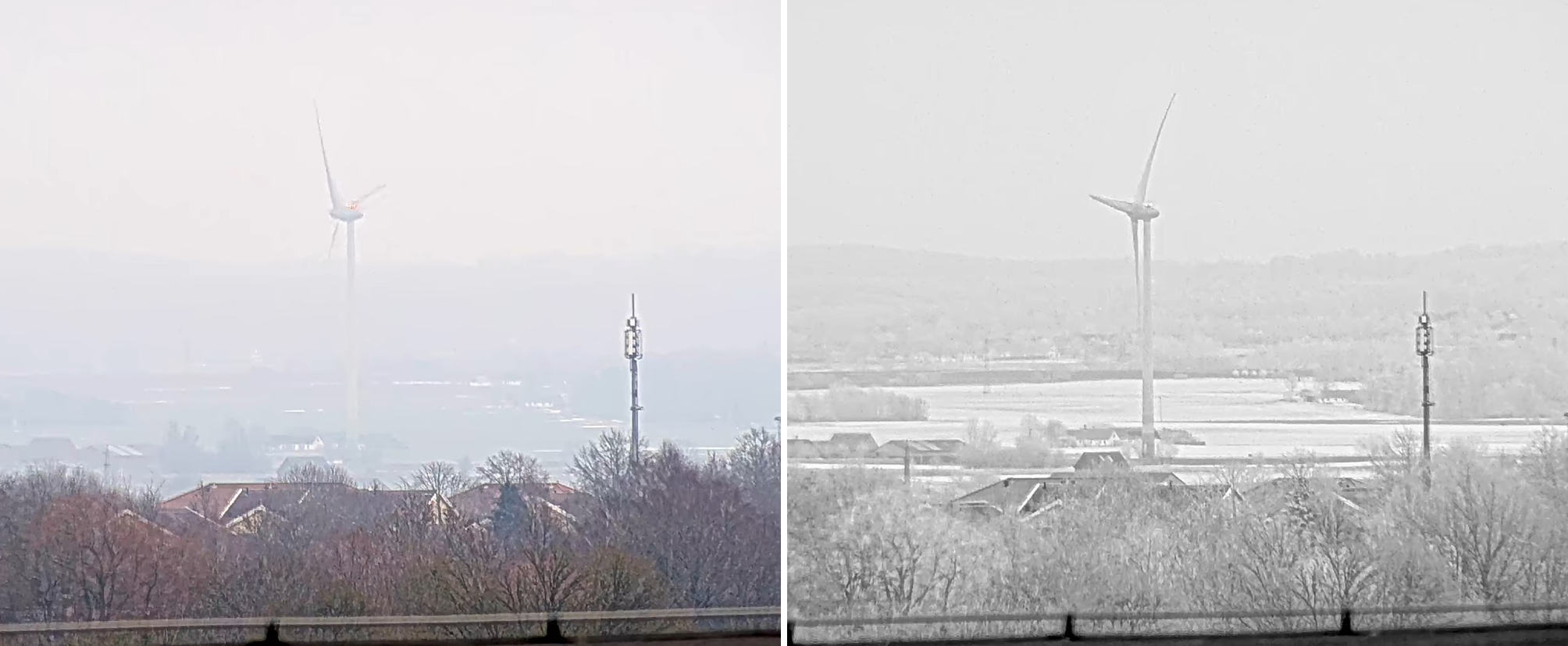
Long-range surveillance. NIR light penetrates haze and smog better than visible light does. This is because the longer wavelengths of the IR light are less susceptible to scattering by atmospheric particles like water droplets or dust. Another striking characteristic of IR imaging is the improved visibility of vegetation, where the high reflectivity of chlorophyl in this spectral range makes plants and trees appear much brighter than they do in visible light. With the IR-pass filter, both these effects can help to enhance visibility and contrast at long distances and make it easier to, for example, search for smoke or emerging forest fires.
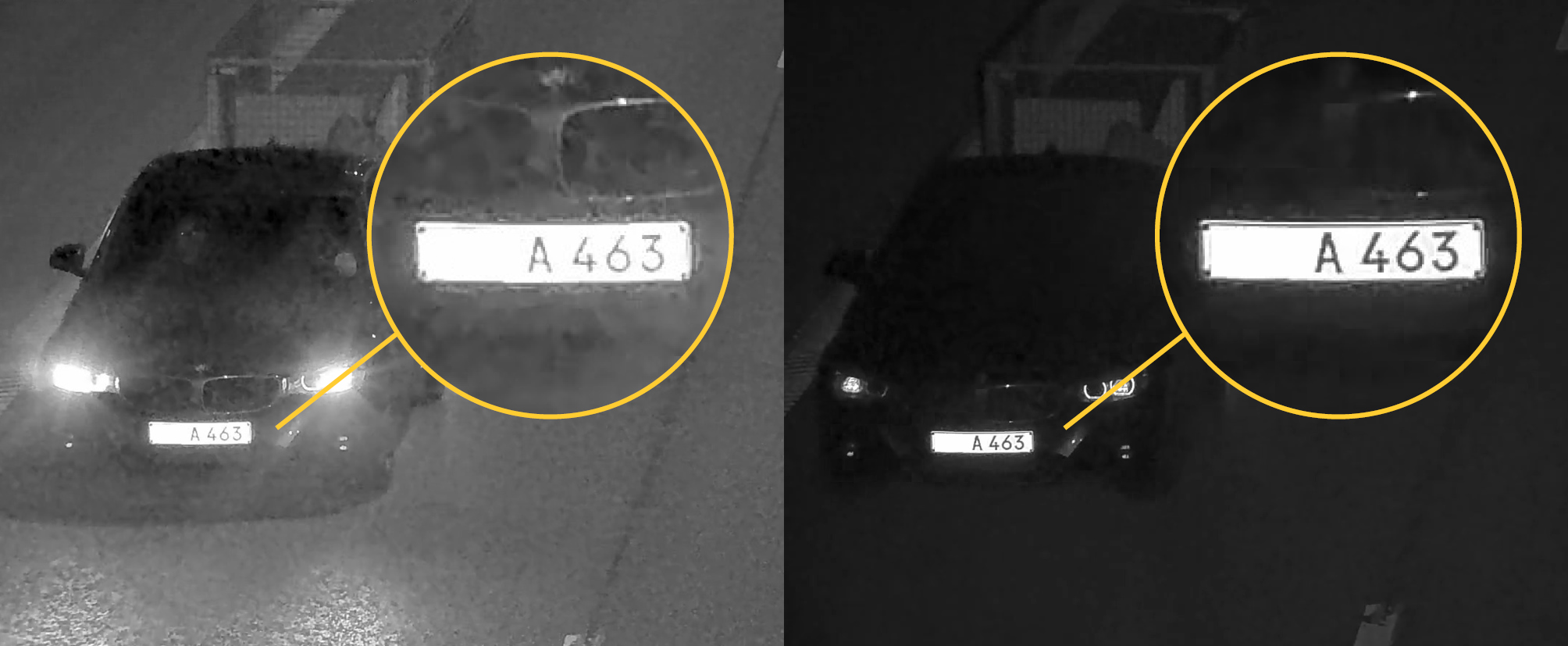
Traffic monitoring. The IR-pass filter can improve the contrast of license plates at night, when used together with IR illumination. Even though license plates reflect IR light especially well, strong headlights can create flares and halos that impair the visibility. Most car headlights emit mainly visible wavelengths, which means that the IR-pass filter will remove the intrusive light.
Why use IR imaging instead of a thermal camera?
Usable video in complete darkness can be provided by thermal cameras, as well as by visual cameras with IR illumination. Thermal cameras don’t need any light source since they detect only heat radiation, naturally emitted by all objects.
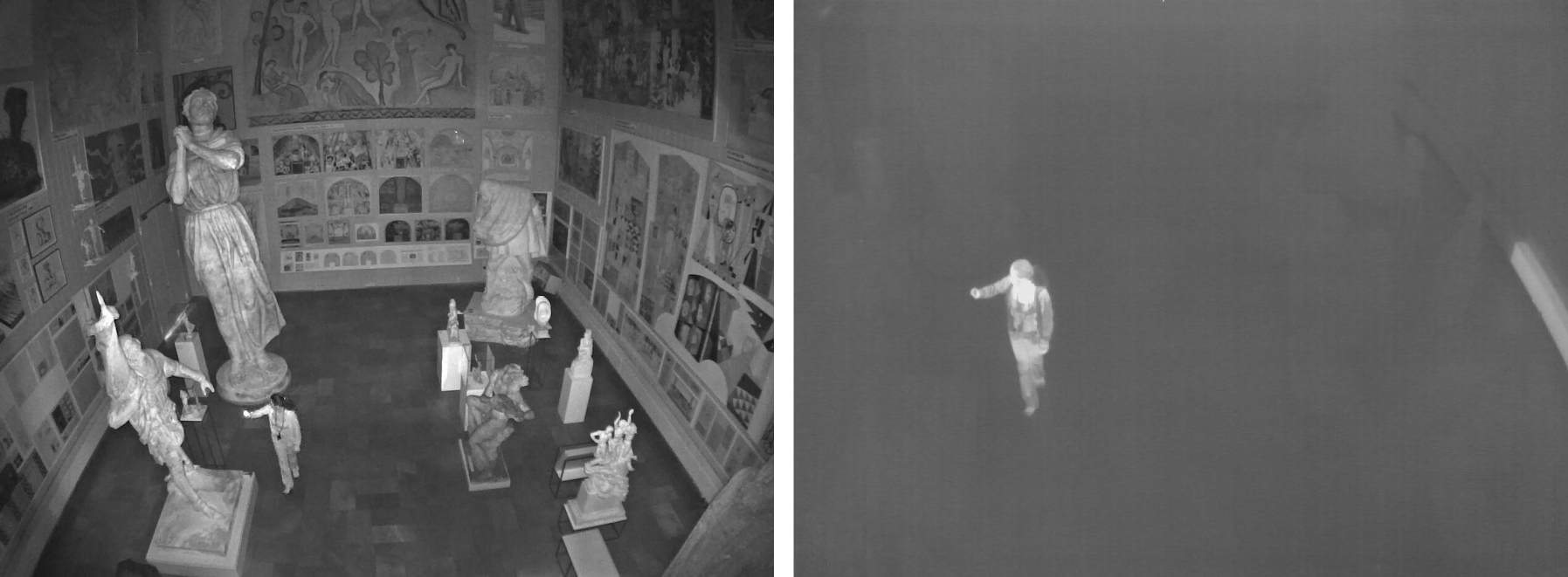
Left: Image from a day-and-night camera with integrated IR illumination.
Right: Image from a thermal camera, passively detecting heat radiation.
The two camera technologies generally serve different purposes: thermal cameras mainly detect presence, while IR cameras can, depending on the conditions, be used to recognize or identify individuals. Cameras with built-in IR can thereby be used for complete, standalone surveillance, but can also be integrated into a larger, diversified, surveillance system. Thermal cameras, on the other hand, can very well complement a surveillance system, but not replace it; visual cameras are generally needed somewhere in the system for identification.
Thermal cameras have an impressive range of detection, counting in kilometers, but they are expensive to buy. The range of a visual camera with IR illumination depends on the resolution of the camera and how far the illumination reaches. For Axis IR products, the datasheets provide information about the illumination reach, as assessed outdoors at night, for real objects in real scenes.
Thermal cameras cannot see through glass, but visual cameras using IR illumination can. The effects of this aspect depend on the circumstances and the surveillance purposes. For example, using a thermal camera could be beneficial in indoor surveillance since it would prevent accidental filming out the windows, where surveillance may not be permitted.
For more information about thermal camera technology, see: www.axis.com/technologies/thermal-imaging
Why use IR illumination instead of visible-light illumination?
In locations where artificial white light illumination is restricted, or where it would be too intrusive, IR illumination provides a way to make surveillance possible.
One example is in nighttime traffic surveillance, where white light could be too disturbing for the drivers. IR also benefits from enabling very discreet surveillance, strategically useful in many scenarios, apart from not adding to general light pollution. The deterrent effect of visible light illuminators is, however, often preferred.
IR illumination can be used when it is not critical to capture color information. But grayscale video also has a significantly lower bitrate than color video, which means that bandwidth and storage needs are reduced.
The superior contrast and low noise levels delivered by a day-and-night camera with IR illumination also makes it particularly suitable both for video analytics and for night-time surveillance of high-speed objects, such as, again, traffic surveillance. License plate recognition (LPR) is a video analytics application that, in some cases, benefits from IR illumination. License plates reflect much more IR light than any other objects in the image, enabling the LPR algorithm to react on license plates and nothing else. Any unauthorized modifications to license plates are also easily detected.
IR-compensated lenses
To fully benefit from IR illumination, optical systems must perform consistently across visible and near-infrared (NIR) spectra. Conventional lenses often exhibit focus shift, where the focal plane moves when the camera switches between visible and NIR light. This effect is caused by the wavelength‑dependent refractive index of optical glass, which results in slight variations in focus position and can lead to reduced sharpness when the camera relies on IR illumination.
IR-corrected lenses mitigate this issue. Through specialized glass and optical designs, they minimize chromatic focal displacement and stabilize the image plane across wavelengths. This ensures consistent sharpness as illumination changes, enabling dynamic IR adjustments and reliable, high-quality image capture in darkness.
Camera-integrated or standalone IR illumination?
Artificial IR illumination can be supplied by standalone IR illuminators or be integrated into the camera. Surveillance applications may benefit from using both types simultaneously. Standalone illuminators are generally more powerful and reach further, but camera-integrated illuminators may be more suitable at shorter range, due to them being uniquely adapted and tailored to the specific camera with its features, zoom levels, and so on.
General IR illuminator requirements
An IR illuminator, whether camera-integrated or standalone, should provide a uniform light field within the camera’s whole field of view. It should have a long reach, but also avoid causing the camera to overexpose objects that are close by. This generally requires a camera with wide dynamic range.
IR illuminators should have integrated visual light detectors and automatically shut down, for power saving, during day or when other light sources provide enough light. Overheating of the LEDs must also be avoided, to enable long LED life.
Integrated illuminators
With camera and illumination in one device, the complete installation is more discreet. This is especially important for surveillance in older or listed buildings, such as museums and historical buildings.
Axis cameras with built-in IR are easy to install and integrate. They don’t require any external cables or extra power supply since their low-power IR LEDs are powered from the camera, using Power over Ethernet (PoE). A system with camera-integrated illumination can also be less expensive, with fewer components to install, and, consequently, fewer components to perform service and other maintenance on.
Standalone illuminators
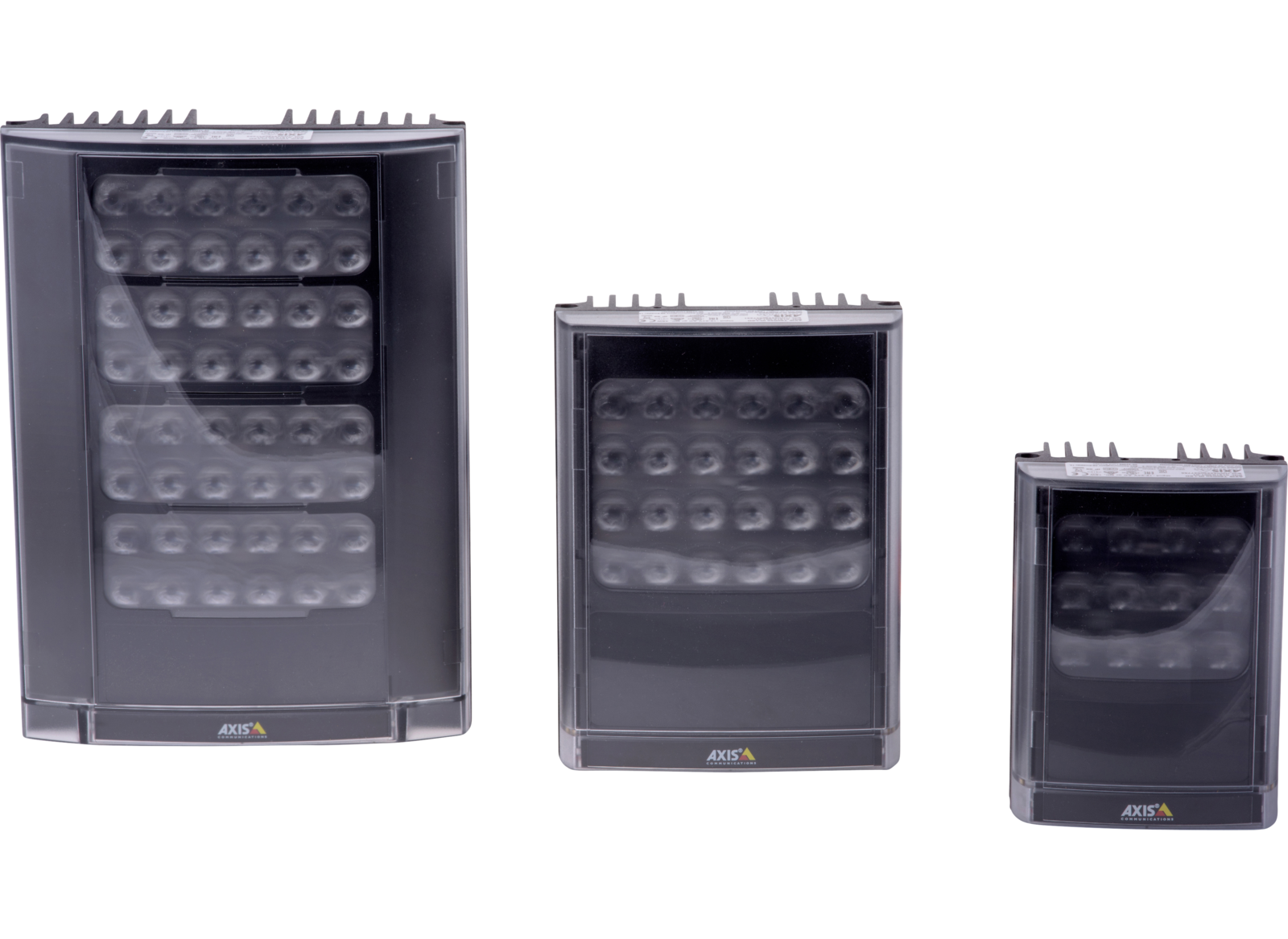
Standalone IR illuminators, to be used with day-and-night cameras, generally provide longer reach than camera-integrated IR illumination, since they use a larger number of LEDs and give more light. More illuminators can be used, and positioned freely in the target area, to significantly expand the illumination coverage. They also allow the camera to be aimed more freely.
Since light and camera lens are more physically separated when standalone illuminators are used, compared to camera-integrated IR, insects and dirt that are naturally drawn to the light don’t get so close to the lens that they can negatively affect the video.
When using standalone illuminators, it should be ensured that the illumination matches the scene. A too narrowly illuminated area will cause white out or glare in the middle of the scene and inadequate illumination at wider angles. On the other hand, a too widely illuminated area entails both reduced light reach in the forward direction, and unnecessary illumination of objects that are outside the area of interest.
Standalone illuminators from Axis come with exchangeable, diverging lenses, to enable an illumination width that suits the scene. Since any adjustments of the illuminators must be done manually on site, standalone illuminators are best used with cameras that keep a rather constant zoom level and field of view.
Axis OptimizedIR
Axis cameras with OptimizedIR provide a unique and powerful combination of camera intelligence and sophisticated LED technology using Axis most advanced camera-integrated IR solutions. Examples include a patented technology for assuring consistent, uniform illumination in the camera’s variable field of view, extremely efficient heat management, and the use of long-range, high-quality LEDs that are fine tuned to the camera. OptimizedIR is tailored to each camera model, and can consist of different solutions depending on the camera’s specific prerequisites and functionalities. OptimizedIR is also in continuous development, with new advanced features being regularly added.
Flexible illumination angle
One feature of OptimizedIR, used in selected, remote-zoom cameras, is that the angle of illumination can adapt to the zoom level. Using high-precision, custom-made lenses, the IR LEDs provide an illumination angle that follows the camera’s zoom movements to always provide the right amount of light. The entire field of view is equally illuminated, resulting in well-exposed, high-quality, low-noise video, even when the environment is completely dark.
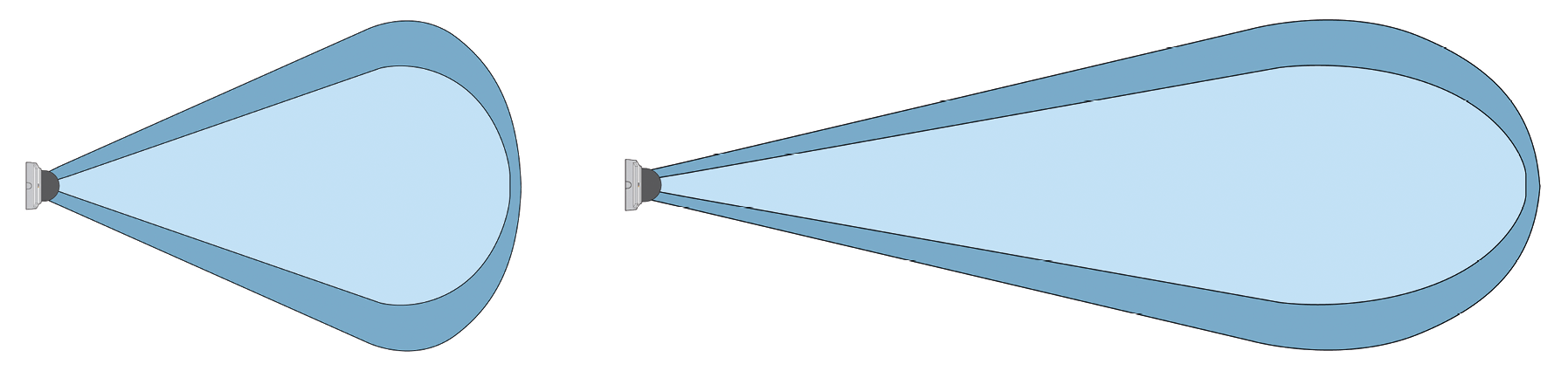
Left: The IR illumination angle is slightly larger than the camera’s angle of view to ensure equal illumination within the whole camera view (light blue).
Right: If the camera’s angle of view is decreased, the IR illumination angle is automatically decreased too.
Adjustable light intensities
In some of Axis most advanced solutions, the intensity of the camera-integrated LEDs can be manually or automatically adjusted. If needed for optimal image quality, individual lights can be either dimmed or turned off remotely via the web interface.
The camera automatically adjusts the exposure for optimal image quality. When installed close to a wall or a corner, it can also be beneficial for the camera to automatically dim the LEDs located closest to that wall or corner, in order to avoid reflections that could otherwise saturate parts of the image.
Depending on the installation environment and the conditions around the camera, for example, external light sources in the scene, manual intensity adjustments of individual LEDs may also be useful for customizing the IR illumination.
Power efficiency and durability
OptimizedIR is based on extremely power-efficient LEDs. Powered by PoE, no additional power cables are needed.
The LEDs are high-quality and durable, and their life is further prolonged because of their low heat generation. With a lower operating temperature, the LEDs last longer. OptimizedIR is a power-efficient technology also because it illuminates the scene evenly and minimizes the amount of light outside the view. This is achieved by using few LEDs, with an optimized mechanical design.
PTZ camera customization
Thanks to advanced heat management solutions and sophisticated camera features, Axis offers OptimizedIR also in selected pan-tilt-zoom (PTZ) cameras. Using several LEDs with different lenses and variable light intensities, the resulting illumination is optimally adjusted for the field of view and zoom factor. Whether the camera is panning, tilting, or zooming, this dynamic IR beam control adapts the IR light seamlessly to the camera view.
For a discreet design of a PTZ camera, any integrated LEDs must be located close to the image sensor, without being connected to any external heatsink. This makes cooling of the LEDs critical.
Axis PTZ cameras with OptimizedIR use heatpipes for conducting LED-generated heat away from both the sensor and the LEDs, allowing those to maintain a suitable operating temperature. This enables the sensor to produce high-quality, low-noise images, and ensures long LED life. The heat management solution also enables a compact and directionally discreet dome design, which, together with the near-infrared lighting of OptimizedIR, provides fully discreet surveillance.
Reflections in cameras with integrated IR illumination
Cameras with integrated IR illumination can sometimes suffer from reflections. A portion of the IR light could either leak directly into the lens or reflect back into it. This light typically reflects off nearby objects or surfaces such as walls, eaves, or ceilings. Additionally, debris on the dome surface, like dirt, spider webs, water droplets, or snow, can also cause reflections. Such reflections ultimately diminish image quality, leading to foggy effects in the image or mirror-like distortions within the dome itself.
Camera design for minimized IR reflection
An optimal camera design effectively isolates the IR LEDs from the camera lens. This can be achieved through a comprehensive three-part shielding approach.
An internal black wall establishes a physical barrier between the lens and the IR LEDs.
The dome's plastic incorporates a black shield that prevents light interference between the IR compartment and the lens compartment.
An external, protruding edge on the dome is designed to stop raindrops from channeling light across the surface towards the lens area.
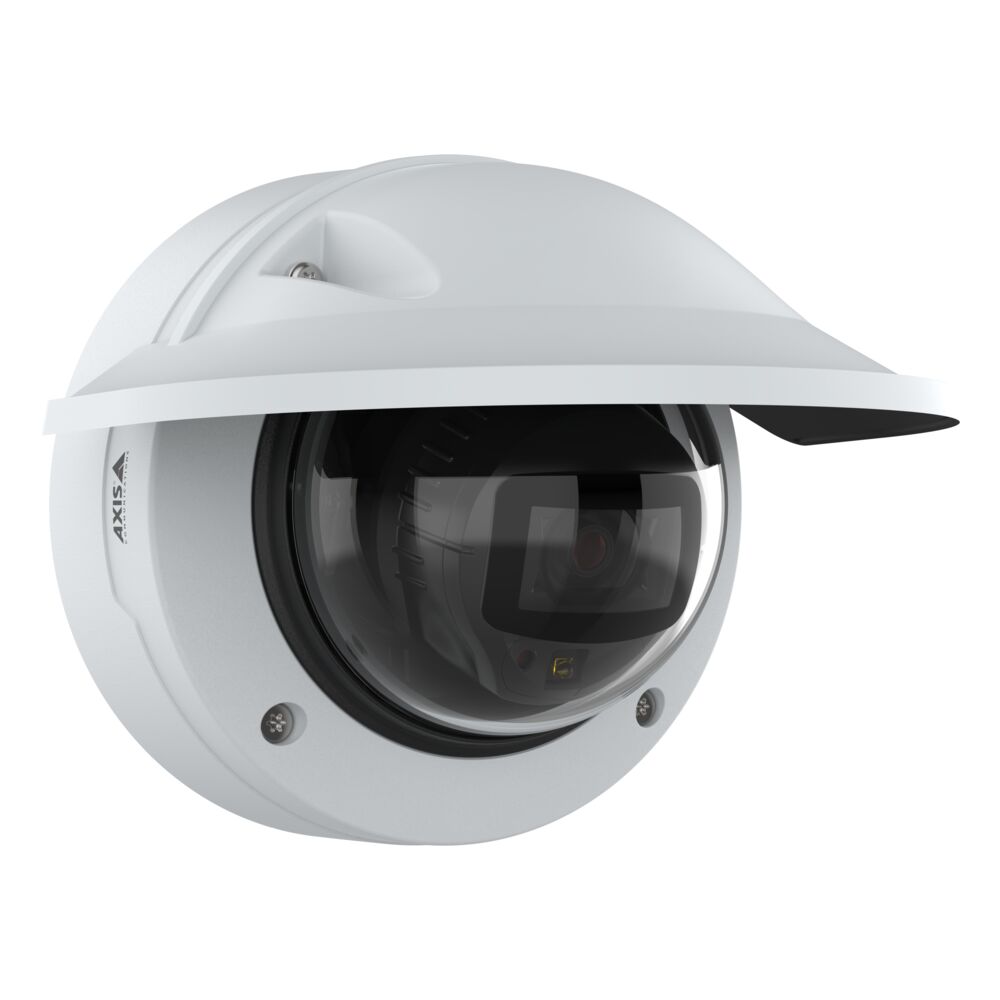
For cameras without these integrated isolation features, an external weathershield offers an alternative solution by helping to keep the dome clear of rain or snow.
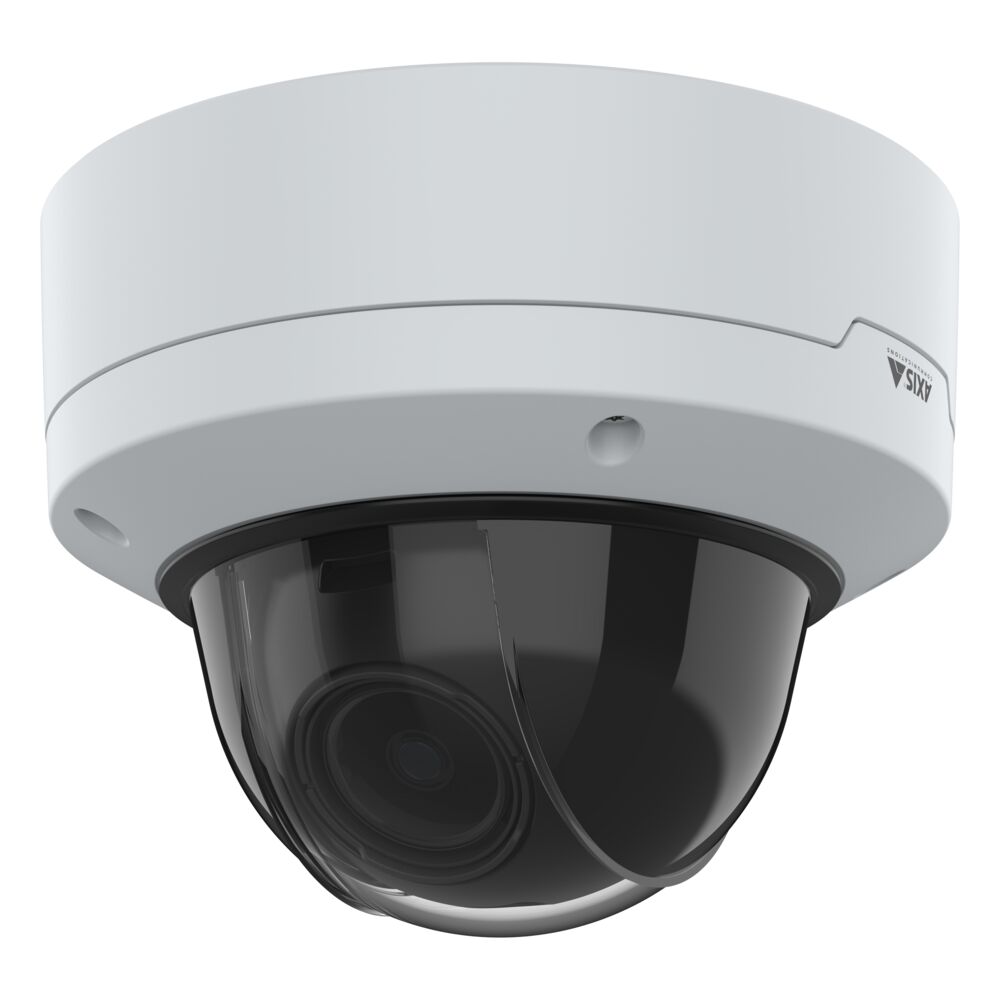 |  |
Left: This camera with integrated IR LEDs uses all three shielding approaches to prevent IR reflections.
Right: This camera with integrated IR LEDs has an internal wall as a barrier between the lens and the LEDs, and a weathershield.
Axis OptimizedIR can help prevent reflections against nearby objects. Because this technology minimizes light that extends beyond the camera's field of view, it significantly reduces the risk of the IR beam hitting and reflecting off adjacent surfaces. Additionally, OptimizedIR offers the flexibility to adjust the intensity of the IR LEDs, further reducing potential reflections.
Another method to mitigate reflections involves using a semi-smoked dome, which features a light tint. However, it's important to note that a semi-smoked dome will also reduce the camera’s general light sensitivity.
Installation choices for minimized IR reflection
For further prevention and reduction of reflections, you can install the camera in a location that offers protection from the weather. If dust or dirt causes reflections, clean the dome regularly.
When positioning and aiming the camera, make sure that the IR beam remains clear of nearby walls, poles, ceilings, windows, or other highly reflective objects. It's important to recognize that relying solely on the video image might not always accurately determine if an object is within the IR beam path. This is because a camera's angle of IR illumination can be wider than its angle of view, particularly in models without OptimizedIR.
Safety in Axis IR equipment
Axis cameras are safe to use according to the European standard EN 62471, based on the international standard IEC 62471. Complying with this standard, the cameras and their built-in illumination are not harmful to the eyes of any living creature looking straight at the camera.